
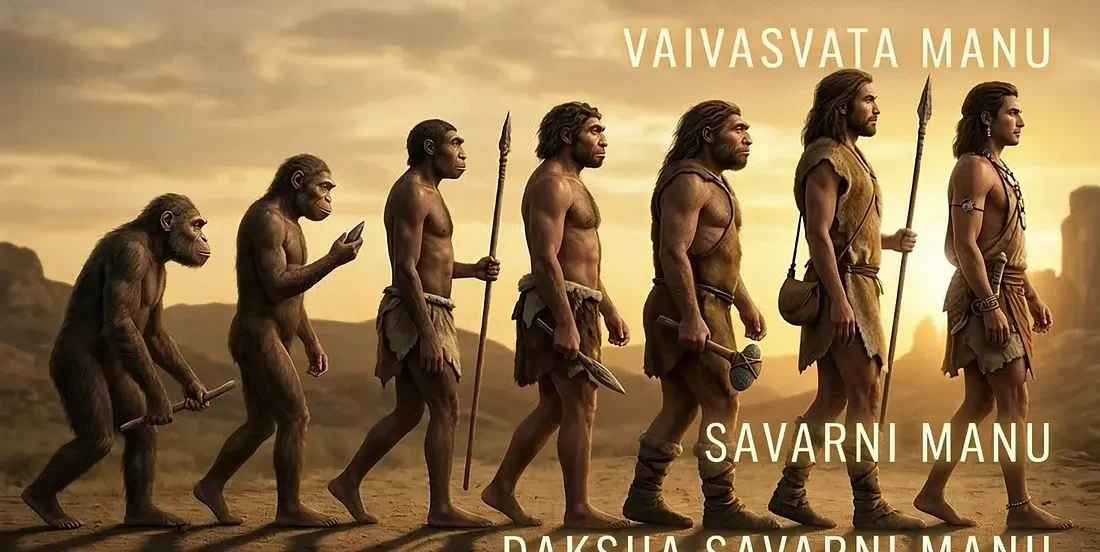
The Evolution
To reach Vaivasvata Manu let first understand evolution. Around 3,800 Mya (million years ago), the first living forms arose in the ancient oceans, simple single-celled beings that knew nothing but survival. By around 600 Mya, the oceans were alive with diversity, soft-bodied creatures. Afterward Fish appeared, mastering movement in water, developing eyes to sense light and fins to command direction. Around 375 Mya, creatures emerged that could breathe both water and air. These were the first amphibians. As ages turned, land hardened and forests spread.
By 320–300 Mya, reptiles arose. They ruled the land for vast stretches of time, evolving into countless forms. Around 66 Mya, a great ending arrived, not as punishment, but as transition. The fall of a celestial body and the upheavals of Earth ended the reign of the dominant reptiles. From this ending came opportunity. Mammals, small and unnoticed for ages, began to rise. Warm-blooded, nurturing their young, adapting quickly, they spread across continents.
Human Evolution
By 20 Mya, forests echoed with the movements of early apes. These beings climbed, swung, and observed. Their hands grew dexterous, their brains larger, their social bonds stronger. Then, between 7 and 5 Mya, a decisive transformation occurred. Certain apes began to walk upright. Their spines straightened, their hips reshaped, and their hands were freed from locomotion. This was not yet humanity, but the threshold of it. Upright walking changed how these beings saw the world, lifting their gaze to the horizon, altering their sense of space, time, and threat. From now evolution emerged in two great streams. First in Africa, where dryness preserved form, Where the land fossilizes, history appears fixed. Second in Pliocene Indian Subcontinent, where life never stopped renewing itself, where the land lives, history remains fluid in the fertile land, where life continued without leaving deep scars in the soil.
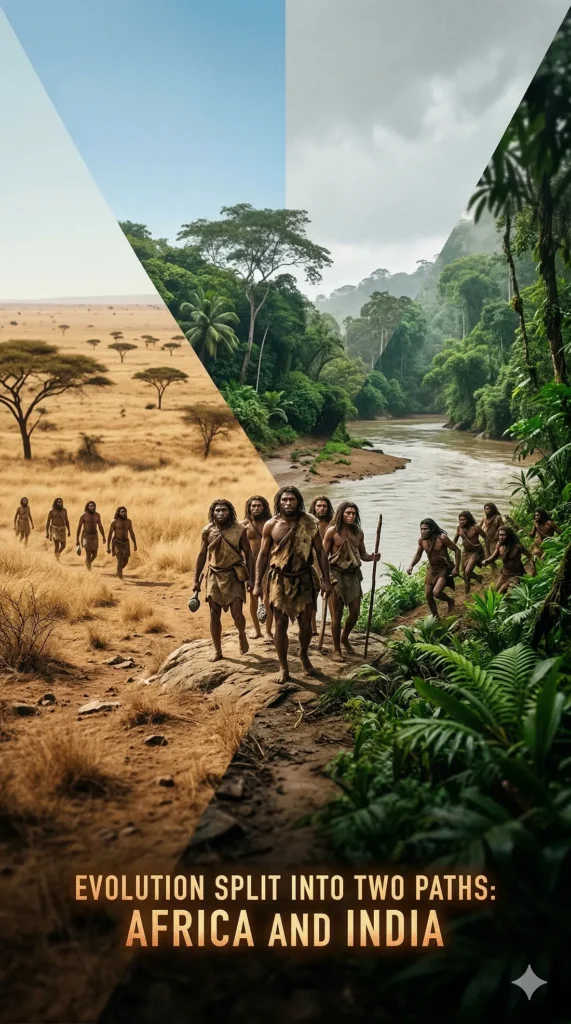
Evolution in india
In India, this age marked the beginning of the First Manvantara, the era of Swayambhu Manu. These early bipedal beings, appearing between 5.4 and 4.6 Mya. Upright posture had freed the hands, but the mind still followed the rhythms of survival. These early walkers lived close to forests and open grasslands, adapting to shifting climates. Swayambhu Manu’s age was not the birth of civilization, but the birth of possibility. The First Manu’s people lived, adapted, and vanished into continuity, leaving behind not fossils, but lineage. Their brains grew slowly, shaped not by sudden insight but by repeated challenge.
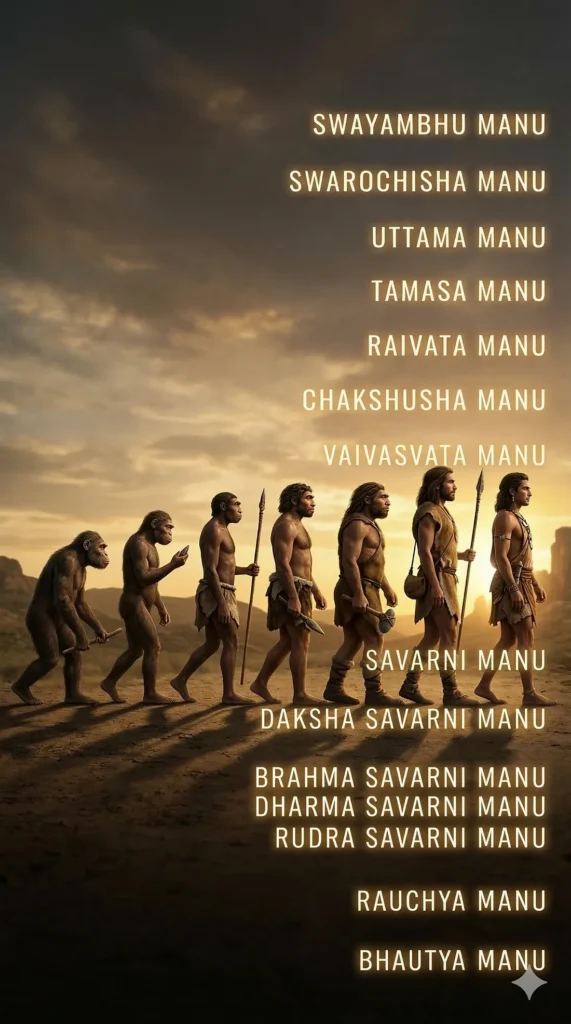
This transition carried life into the time of the Second Manu, The Swarochisha Manu. In Swarochisha’s age, roughly 4.6 to 3.7 Mya, the upright beings became more assured of their form. That balance was mastered before intelligence could rise. These hominins are like dominant Australopithecus. They walked confidently, climbed when needed, and lived in social groups bound by recognition and response rather than language. Their world was one of gesture and sound, warning and imitation.
Time moved onward, and with it came the Third Manu, The Uttama Manu. This was the age when thought first touched matter. Between 3.7 and 2.9 Mya, certain beings learned that tools could extend the hand. The earliest tools appeared, crude flakes struck not with foresight, but with discovery. Toolmaking did not arise everywhere at once. In Africa, stone endured and recorded the moment. In India, bamboo, wood, and perishable materials served the same purpose and vanished. Thus, scholars of the future would see this Manu’s timing as uncertain, mistaking absence of stone for absence of mind.
As climates fluctuated and grasslands expanded, life entered the age of The Tamasa Manu, between 2.9 and 2.0 Mya. This was a time of discipline and endurance. Bodies grew taller, legs longer, and brains incrementally larger. These beings, early Homo learned coordination, planning, and persistence. They were like Homo Habilis They hunted not by speed, but by patience. This age as one in which survival became organized. Fire was approached, feared, and finally used, not yet mastered but understood as power. Migration accelerated.
Then came the long and defining age of Raivata Manu, spanning approximately 2.0 to 1.2 Mya. This was the era like Homo erectus, the true wanderers of Earth. Fire was now controlled. Shelters were built. Journeys extended beyond memory. These humans crossed rivers, and mountains, carrying with them a shared form and emerging culture.
With Raivata’s age complete, humanity entered the realm of The Chakshusha Manu, from roughly 1.2 to 0.342 Mya. For this was the age of awakening. Minds began to turn inward. The dead were no longer abandoned, they were placed, covered, remembered. Symbols appeared, not as writing, but as intention. Tools diversified. Faces changed, skulls expanded, and the mind began to reflect upon itself. These were like Archaic homo sapiens, standing at the threshold of awareness.
The Vaivasvata Manu, First Homo Sapiens
The Evolved version of Archaic homo sapiens was the Seventh Manu, The Vaivasvata Manu, chosen and saved for later generation by Vishnu itself around 342,420 years ago. This Manu was anatomically modern humans marks a profound turning point in the long memory of humanity. His age is remembered not merely as a succession of years, but as a transformation of consciousness itself. Around this epoch, humanity crossed an invisible threshold. Instinct no longer ruled alone. The mind awakened to reflection, and awareness turned inward as well as outward.
Under This Manu, humans began to speak not only to warn or command, but to narrate. Language became a vessel for memory. Experiences were no longer lost with death, they were preserved as stories, symbols, and shared meaning. Elders transmitted knowledge, customs crystallized into laws, and society emerged as a moral structure rather than a biological accident.
This Manu is remembered as the lawgiver because he gave form to living together, defining kinship, duty, restraint, and responsibility. Survival evolved into purpose. Humanity began to ask why it exists, not only how it endures. The world itself was reimagined. Rivers became sacred, sky and earth acquired meaning, and time was perceived as cyclical rather than fleeting.
Vaivasvata Manu thus stands at the dawn of reflective humanity, the First Homo sapiens not only in body, but in mind. His legacy is the realization that thought leaves traces deeper than footprints, and that memory, once awakened, shapes destiny across ages.
The following is the Illustration for the timeline for different Manu in each manvantara.
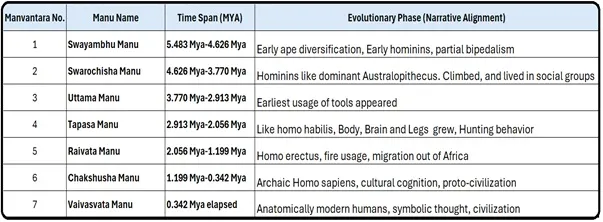
In each manvantara, 71 Maha Yuga of each 12000 years period has elapsed. In the current manvantara i.e. 7th, 28 Maha yuga has been elapsed. We are currently in 29th Maha yuga.
Related Books on Online plateforms
https://www.amazon.in/dp/9375424383
Other Website links :
https://feelfreetoread.in/books/decoding-abraham-with-shukracharya
https://fable.co/book/decoding-abraham-with-shukracharya-by-priyaranjan-9789378251375
https://www.bol.com/nl/nl/p/decoding-abraham-with-shukracharya/9300000274289928
Other Posts :